
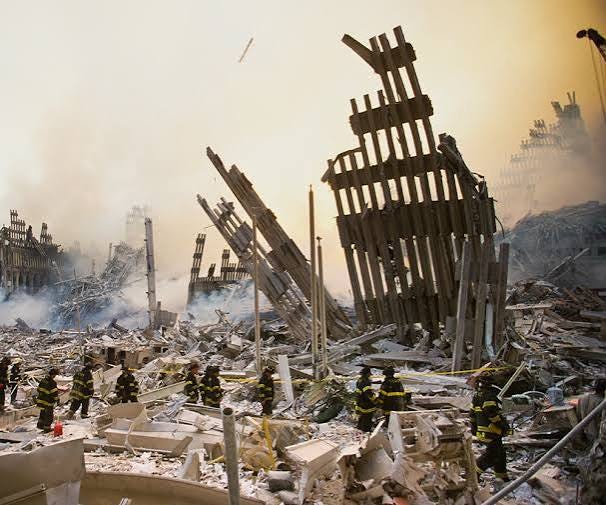
Prince George, BC, September 15, 2026/ - For anyone over the age of 30, the September 11, 2001, attacks on the United States left an indelible mark. Everyone knows where they were when they heard the news.
The world has changed dramatically in the last 25 years. If we are to move forward, we need to discuss this event, its consequences, and the impact of decisions made in the aftermath without condemning one another. Jewish American political commentator Peter Beinart recently stated, “We should have realized how conceptually, morally crucial it is to be able to say we can have a conversation about why something happens without justifying that action.”
The horrific attacks of 9/11 resulted in the immediate deaths of nearly 3,000 innocent people. Rather than reflecting rationally on what happened and how to respond in a principled manner, world leaders and many others reacted in anger and fear with little regard for the dignity of human life.
The result has been a tragic spiral of violence, contributing to the instability the world finds itself in at this moment.
Had we responded with empathy, we would have said, “This is terrible. I would not wish such suffering upon anyone else.” Instead, Americans and their allies, including Canada, almost immediately began attacking Afghanistan, causing 20 years of war, costing the United States alone trillions of dollars, and resulting in a humiliating defeat.
The so-called War on Terror expanded into Iraq in 2003. According to the Watson School of International and Public Affairs at Brown University, “An estimated over 940,000 people were killed by direct post-9/11 war violence in Iraq, Afghanistan, Syria, Yemen, and Pakistan between 2001-2023. Of these, more than 432,000 were civilians.”
The aftermath of the 9/11 attacks resulted not only in military deaths in the United States and its coalition partners, including 158 Canadians, but also in further civilian deaths. Rather than deal with the health risks caused by the toxic dust resulting from the collapse of the World Trade Center, New Yorkers were encouraged to get back to their normal lives. According to the World Trade Center Health Program, this resulted in over 9,000 more deaths.
Because those who were responsible for the 9/11 attacks were extremist Muslims, we saw a shocking rise in already elevated levels of Islamophobia. Even as a non-Muslim Arab, I knew that I had to keep my head low. Islamophobia continues to reverberate in Western society at frightening levels. An angry reaction to a recent article I wrote resulted in an obscenity-laden phone call from a reader who sneered, “You’re Muslim, aren’t you?”
Is it fair to say that people should not be held accountable for their reactions, given the shock of the 9/11 attacks? An important part of being a self-actualized human being is recognizing that we always have a choice. Before responding to a provocation, we can reflect on our principles. We ask, “What is true? Are my anger and fear justified? What will be the consequences of each response? Isn’t every human life of equal value, no matter where a person lives or what religion they follow?”
Reflection on these questions resulted in the best decisions made in the wake of 9/11. The people of Gander, Newfoundland, opened their homes to thousands of stranded travelers whose planes had been ordered to land at the nearest airport, fostering many lifelong friendships. When pressured to join the Americans in attacking Iraq in 2003 over allegations that Iraq had weapons of mass destruction, Canadian Prime Minister Jean Chrétien wisely declined, stating that the Americans could not prove that it was true.
Every person is capable of self-reflection and critical thinking. We need to insist that our leaders do the same, recognizing that the decisions we make can have a multigenerational impact.
When historians write about the events of September 11, 2001, in another 25 years, will they see it as a key moment in the self-destruction of the American Empire?