
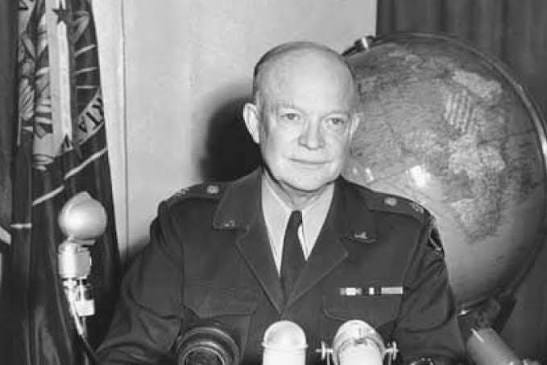
Dwight Eisenhower arguably did more to defeat fascism and tyranny than any other person. He was the Allied commander in World War II and later served two terms as American President. During an address at the Canadian Club in Ottawa in 1946, he stated, “I hate war as only a soldier who has lived it can, only as one who has seen its brutality, its futility, and its stupidity.”
Eisenhower led the United States through a very precarious time in world history, the early years of the Cold War – a period defined by careful, calculated diplomacy.
After World War II, the Soviet Union expanded into satellite countries in Eastern Europe, forming the Iron Curtain. Despite being officially recognized as a liberated “first victim” of German expansionism, Austria, like Germany, was divided into four military zones and occupied by American, British, French and Soviet forces. In 1955, the multilateral Austrian State Treaty was signed. Austria agreed to permanent international neutrality, and all foreign forces left. It was one of the only regions that the Soviet Army withdrew from, and Austria became an important geopolitical buffer zone for the remainder of the Cold War. Eisenhower saw the wisdom of this agreement, and he supported it.
Several highly respected public intellectuals, including economist Jeffrey Sachs and political scientist John Mearsheimer, recommended using the Austrian model to calm tensions between Western powers, Ukraine, and Russia in the 21st century. In the years leading up to the 2022 invasion, settlements were negotiated, including the Minsk agreements. Shortly after the Russians attacked Ukraine, a truce framework was nearly reached in Istanbul, Turkey. Analysts like Sachs and Mearsheimer place much of the blame for its failure on former British Prime Minister Boris Johnson, but this is disputed. The tragedy is that Ukraine has suffered years of death and destruction as a result. One wonders what Eisenhower would have thought.
More recently, American President Donald Trump launched a war with Iran. He does not seem to be mindful of the fact that Iran is a country roughly the size of Western Europe with a population of over 90 million. Iran also has a vast arsenal of sophisticated, long-range missiles that are largely inaccessible to the Americans. After years of supplying the war in Ukraine and supporting the Israeli military, American weapons stocks are low. In addition, according to weapons expert Ted Postol, the effectiveness of American technology to defend against Iranian missiles has been grossly exaggerated.
The result is that the assets of the American military and their allies in West Asia are being heavily damaged, and the American weapons arsenal will be difficult, if not impossible, to replenish. Many are questioning whether the Americans can win this war. The power balance in the region will likely be changed for the foreseeable future due to Trump’s military aggression.
Both wars put the world at tremendous risk, carrying a distinct threat that they could merge. The Americans and Russians maintain vast stockpiles of nuclear weapons, and it is reported that the strongest American ally in West Asia, Israel, has an active supply. There is also speculation that Iran has developed its own deterrent. If pushed to desperation, will any of these states choose the nuclear option?
In addition, the flow of petroleum products from West Asia has been severely restricted by the current hostilities. This not only increases the price of gasoline and diesel, but it also impacts the entire global economy. It could trigger a crisis in food production, resulting in starvation and mass migration.
It is time for world leaders to recognize that we cannot continue to pursue our current path of destruction. Eisenhower, unlike Donald Trump and his cohorts, knew the reality of war.
The international community must embrace the option of peace and work to reverse the tragedy that has been unleashed.