
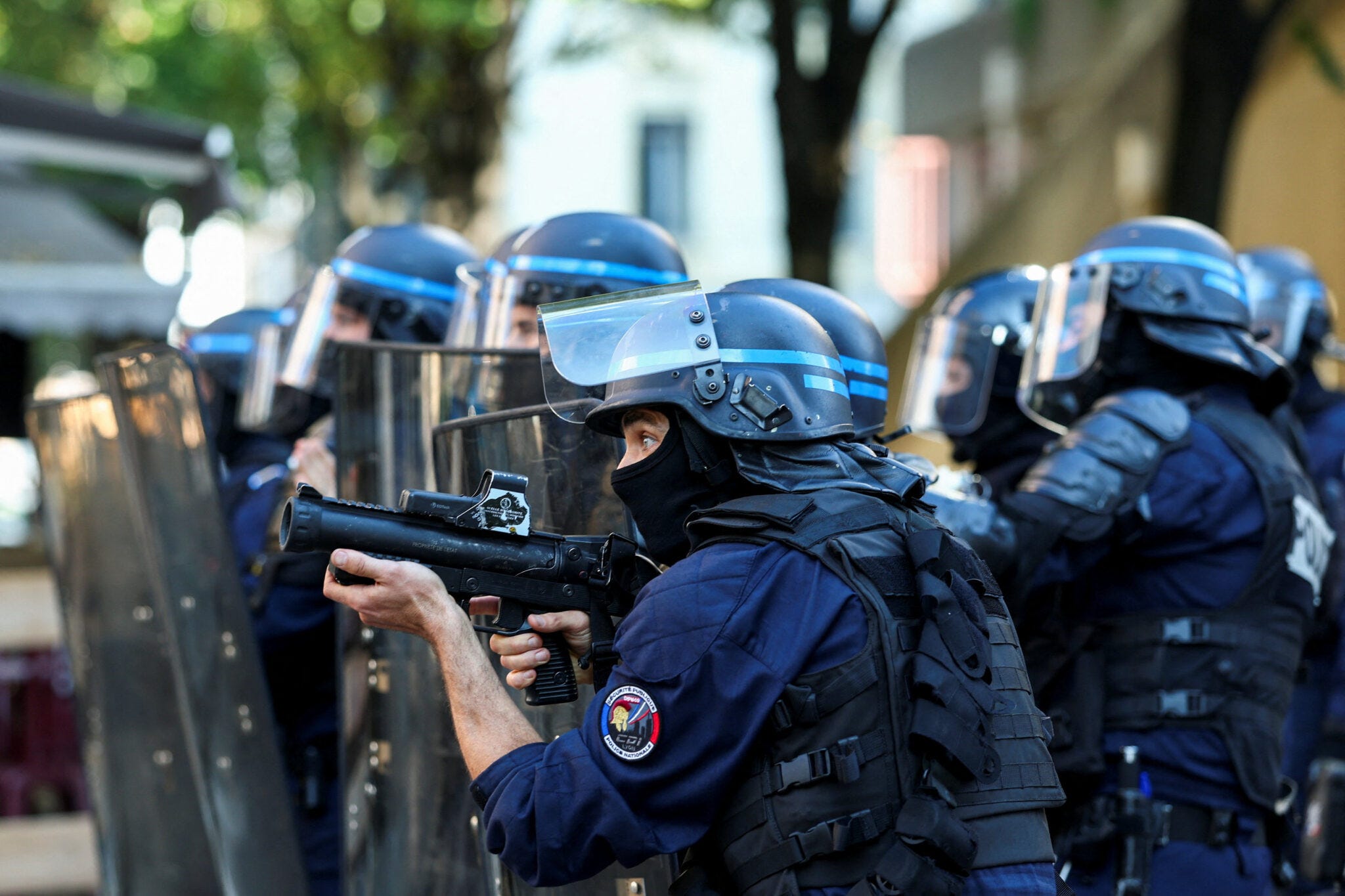
Seeing children attacked by baton-wielding riot police in France is one of the most horrific things I have ever seen. Students are literally bleeding in the streets due to the indiscriminate and irresponsible use of riot control weaponry.
This time, those who authorize state violence against ordinary people have gone too far, deploying heavy-handed tactics historically used to suppress occupied populations. By treating its own children in this way, the French state is professing a bitter truth: the chickens of colonialism have truly come home to roost.
Protests began peacefully on September 17 in Créteil, near Paris, and soon sprang up all over France, with demonstrators now numbering in the hundreds of thousands. The demands of the students are quite reasonable; they are calling for more teachers and support staff, smaller class sizes, repairs and improvements to dilapidated school buildings, a more balanced workload, and improvements to curriculum and testing. There has been a lack of investment in French public schools for decades. Teacher salaries, for example, are significantly lower in France than in Canada.
Why isn’t investment in education more of a priority in France, and why are students being attacked simply for demanding a quality education?
The mainstream media has emphasized that some protestors have used violence. It is still unclear who the instigators are; in fact, there are allegations that the violence was started by the police. Even if it was not, we need to remember that we are dealing with adolescents. No adult can honestly state that they did not do foolish things when they were young. We also need to remember that this is France, a country that has a tradition of similar “manifestations” that goes back centuries. The one clear thing is that the response of French police has been disproportionate and it is failing to improve the situation.
Seeing youth who look like my own high school students swarmed by police in riot gear is not only gut-wrenching, but also completely unnecessary. If I am an expert in anything, it is in communicating effectively with teenagers and building cooperation. When I treat my students respectfully and insist that they treat me and their classmates with respect, we create a safe and productive environment.
This causes us to ask whether state violence is ever justified. While there are dangerous and dysfunctional people in any society, the vast majority, like my high school students, are quite reasonable. When they are listened to, when their concerns are addressed, the situation is improved without conflict. When they are not, the tension builds.
France is well known for the use of violence, especially in its former colonies. In Algeria alone, historians estimate that up to 1.5 million people were killed before French authorities concluded that their presence was unsustainable.
Algerians had been peacefully lobbying for self-rule for decades, but when their efforts were stymied, they turned to guerrilla warfare. In the Battle of Algiers in 1956 and 1957, the French used a system of spatial containment called “quadrillage” that is frightfully similar to the “nasse”, or kettling, technique used to block the exit routes of student protestors and execute beatings and mass arrests. French authorities also began using tear gas in Algeria and continue to use this substance to terrorize protestors.
In 1968, an uprising in France that began with university students led to a near revolution against the government of President Charles de Gaulle. Police used the next evolution of the quadrillage technique, called souricière, especially in the Latin Quarter, the region of Paris largely populated by students. This led to public outrage and massive protests.
As in 1968, left-leaning organizations are being scapegoated for simply listening to and affirming the students’ legitimate concerns.
Ironically, The 7 Habits of Highly Effective People is a popular book among the corporate class, yet its principles are so rarely practiced by them. Habit 4 is “Think win-win”, Habit 5 is “Seek first to understand and then to be understood”, and Habit 6 is “Synergize.” If leaders can recognize the needs and desires of others rather than fixating on their own self-interests, if they can truly listen to what people are saying, then we can work together to create a better society and a better world.
Without dialogue and compromise, the tensions in France will continue to escalate, and they could easily spread. Frustrations are mounting in many countries for many reasons, from high prices to unpopular wars, from income disparity to failing social programs.
The spirit of revolution is again emanating from France. Our leaders need to learn to listen.
There is a concept called “strategic empathy”. It is the ability to imagine the other. Our culture has lost that ability, or at least our elite classes have. Our elite classes have also lost any sense of History, and seem to feel that events started 5 minutes ago. So Gaza started on Oct 7th. (no need to name the year, and the only people you should have empathy for are the victims of October 7th) Most importantly, because they say it happened this way, it is true. (No asking obvious questions, such as how does a building fall straight down into its own footprint in defiance of the laws of physics, especially if you are an civil engineer as I am)
In 2026 we are all Alice, wandering around in Wonderland.